Who Benefits from the Energy we Spend?
The answer depends on which sector of the economy we're measuring.
All energy we use traces back, directly or indirectly, to the sun. Geothermal, wind, and combustible/fissile materials extracted from the earth supplement what we harvest directly. How we spend that energy is profoundly important.
Those familiar with permaculture will recognize the core tenets: 1) Care for the Earth, 2) Care for People, 3) Return the surplus to the system. We can depict our energy budget using the 1st tenet (x, horizontal) and the 2nd (y, vertical) in a cartesian layout as shown. "Surplus" in our case refers to whatever skills, time, materials, or energy is left over once our needs are met.
Q1 Represents the energy spent benefitting us (+y) but typically at the expense of our cohabitants in the wild and the Earth's regenerative capacity (-x).
Q2 Represents the energy spent benefitting neither people (-y) or the Earth (-x). War is the extreme case.
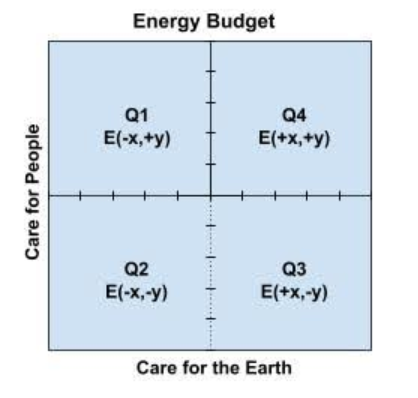
Q4 Represents the energy spent benefiting us (+y) and the planet (+x). The ERN exists to estimate the natural value of human-controlled energy spent this way.
Q3 Represents approaches that prioritize Earth's wellbeing (+x) at the expense of people (-y), i.e. 'cull the herd to save the meadow.'
We can think of the Earth as a bank at which we make energy withdrawals and deposits (Q1–Q4). When we make a cash deposit at a conventional bank we're issued a receipt. The ERN is the clerical utility designed to store evidence of your (Q4) beneficial energy deposit (BED), estimate its natural value (potency, P), and issue your receipt (RCT).